Opinion: What the Nassar Verdict Means For The Rest Of Us

gymnastics-usa-nassar

If you hadn’t heard of him before, the past two years made Larry Nassar a household name. Recently sentenced to anywhere from 40 to 175 years in prison, this physician sexually harassed more than 150 women over the course of 20 years. As we sift through victim testimonies, courtroom recaps, and the impact on USA Gymnastics and Michigan State, it’s easy to succumb to the sense of relief that Nassar is behind bars; however, his sentencing should not be the last time you think of his name. In a period of time plagued by similar accounts of sexual assault, the Nassar verdict should serve as a steadfast reminder of four crucial things.

#1. Nassar is not a minority. Sexual harassment is not a random occurrence perpetrated by mentally unstable individuals; it is a societal epidemic upheld by social norms, gender expectations, and a lack of accountability. In a survey conducted by the Huffington Post, it was reported that approximately 1 in 3 women between the ages of 18 and 34 experience sexual harassment in the workplace, but 71% of women do not report it (Vagianos, 2017). The Equal Employment Opportunity Commission reported 12, 428 reports of sex-based harassment allegations in 2017, with 53.87% being attributed to sexual harassment; this number, as seen by this table, has been fairly consistent since 2010 (2017). Despite our desire to label Nassar’s behavior as uncommon, we must accept the frequency with which sexual harassment occurs in order to acknowledge it as a societal epidemic and institute effective change.

#2. Predators don’t wear a name tag. There seems to be a misconception that potential dangers stick to dark corners, alleyways, or perceptibly hazardous environments; however, there is not a set of guidelines that help you identify a predator. The majority of sexual assaults are perpetrated by someone the victim knows; this degree of comfort acts as a tool in creating opportunities to take advantage of the other party. This is not to serve as a means for distrust, but more so a reminder that certain safety precautions, such as scheduled phone check-ins or group outings, can serve as vital means of preventing rape and other forms of sexual assault.

#3. Not all victims feel comfortable articulating their trauma. Admit it: when you read about Nassar harassing victims for over 20 years, one of your first questions was why didn’t someone say something. This question does not always serve as victim blaming, but more so a genuine lack of understanding as to why the safe space did not exist for someone to bring their experience to the correct authority. There are so many mental and emotional tribulations that accompany sexual assault, such as depression, PTSD, and anxiety, that it is often difficult to come to terms with the abuse. This internal battle is heightened when the environment does not exist to articulate your trauma without fear. To combat this, steps must be taken to prioritize the comfort of victims.

#4. It is our job to hold people accountable. Whether it’s sexual comments, inappropriate jokes, or mild touching, no act of sexual harassment should be considered too meaningless to address. It is the oversight of these behaviors that creates a sense of normalcy around harassment. If we begin to hold others accountable for less extreme behaviors, it defines a more concrete line between what is inappropriate and what is welcomed.

Larry Nassar is a prime example of an individual using a position of power to take advantage of vulnerable parties. This is a pattern; the United States has fallen victim to a rampant cycle of sexual harassment sliding through the cracks. It is our job going forward to not forget his name, his actions, or the outcome. It is our job going forward to create an environment that prevents victimization and holds predators accountable. It is our job to stand with the 1 in 3 women facing sexual harassment and ensure the next Larry Nassar isn’t given the opportunity to become a household name.

*Here is a link to the Larry Nassar article this opinion piece follows up

Looking Into The Larry Nassar Trial

gymnastics-usa-nassar

Larry Nassar, a physician who worked both for Michigan State and USA Gymnastics, was recently sentenced to 40 to 175 years in prison after sexually harassing more than 150 women over the past 20 years. Some of those women came forward even years after they were sexually abused. One accuser even said she was harassed as young as six years old. Nassar had also been sentenced to 60 years in July 2017 for child pornography charges.

“I’m giving you 175 years which is 2,100 months. I’ve just signed your death warrant.”

“It is my honor and privilege to sentence you. You do not deserve to walk outside a prison ever again.”

– Judge Rosemarie Aquilina

This disgusting human being is finally going to go where he belongs; however, this is not the end of this horrific ordeal. Mike Golic and Trey Wingo on the ESPN Radio show “Golic and Wingo” noted this is only “the first chapter.”

“I thought that training for the Olympics would be the hardest thing that I would ever have to do. But, in fact, the hardest thing I would ever have to do is process that I am a victim of Larry Nassar.”

-Jordyn Wieber

Nassar was both an assistant professor and team physician at Michigan State. The school fired him in 2016 after the Indianapolis Star newspaper reported allegations from gymnast Rachel Denhollander. Once Denhollander came forward about what Nassar did, waves of victims, including notable gymnasts Jordyn Wieber, Gabby Douglas, McKayla Maroney, Simone Biles and Aly Raisman, began to share their experiences, with the arguably most notable and impactful testimony coming from Raisman:

“Imagine feeling like you have no power or voice. Well, you know what, Larry? I have both power and voice and I’m only beginning to just use them. All these brave women have power and we will use our voices to make sure you get what you deserve.”

“Larry, you do realize now that we, this group of women you so heartlessly abused over such a long period of time, are now a force and you are nothing. The tables have turned, Larry. We are here, we have our voices and we are not going anywhere.”

Eerily, on the “Today” show, Raisman painted a gut wrenching picture when she described how Nassar would make consistent eye contact with her during her testimony, ensuring not to break it when her eyes met his.

Another powerful moment during the trial came from another of Nassar’s patients, 15-year-old Emma Ann Miller, who started getting treatment from Nassar when she was 10. “I am possibly the last child he will ever assault,” said Miller during her testimony.

But despite justice being served, this is only the beginning of the story. “This is bigger than Larry Nassar. We have to get to the bottom of how this disaster happened,” said Raisman. The scary part of this scandal is that there are probably more victims than cases reported.

“You seem to have a hard time looking at me now, but you didn’t when I was half-naked on your table. What kind of doctor can tell a 13-year-old they are done growing by the size of their pubic bone?”

-Arianna Guerrero

After the trial, USA Gymnastics announced that the entire board of directors resigned in wake of the trial per the request of the U.S. Olympic Committee. Lou Anna Simon, who was the Michigan State president, also resigned.

Recently, a report from The Athlete’s Nicole Auerbach came out saying that NCAA president Mark Emmert was informed about 37 incidents at Michigan State in 2010 and did nothing.

In the lawsuit, it was said that USA Gymnastics covered up the ordeal by making McKayla Maroney sign a $1.25 million non-disclosure agreement. Michigan State had also been accused of enabling Nassar to continue doing what he had been doing.

“The Olympics were just one year away. And I just couldn’t take any more of the abuse. I was broken. Larry, my coaches and U.S.A. Gymnastics turned the sport I fell in love with as a kid into my personal living hell.”

-Mattie Larson

Shortly after the publication of the Indianapolis Star’s investigative report, the Michigan Attorney General’s office brought a criminal case against Nassar for the three charges of first degree sexual misconduct with a person under 13 in November 2016 (this was later increased to 12 in June, 2017). This initial filing led to a number of other court cases, a lawsuit against Michigan State University, US Gymnastics, and Nassar and a sexual assault allegation in Texas. Nassar also plead guilty to an unrelated child pornography charge, for which he was sentenced to 60 years in federal prison.

It smells like there is more to this story than what is being reported.

Did Michigan State and USA Gymnastics not learn from the Penn State University scandal when former defensive coordinator of the football team, Jerry Sandusky, was convicted in 2011 for child sex abuse? These institutional cover-ups echo each other. And they also hint at the potential for other cover ups at collegiate athletic institutions. Larry Nassar worked as a team doctor at Michigan State, pretty low on the totem pole. If the university, from the top of its authority, was willing to overlook the whispers and complaints from within the institution concerning Nassar, then what does that say about the potential for others to abuse students, teenage athletes, minors, etc.?

The desire for institutional protection and insulation from these scandals increases the higher the level of power. There is greater potential for institutional obfuscation and cover-up if the perpetrator is higher up the food chain. It simply begs the question, how many more Larry Nassar’s and Jerry Sandusky’s are being protected?

Either by their status or by an institution that does not want the attention associated with hiring a sex offender. And what happens when an institution of higher education takes the right step and releases someone because of workplace sexual misconduct? These questions have no correct or knowable answers, but we need to consider them in the context of this case, and the future of safety and security for all, particularly in athletic institutions and university campuses.

“Larry is the most dangerous type of abuser. One who is capable of manipulating his victims through coldly calculated grooming methodologies, presenting the most wholesome and caring external persona as a deliberate means to ensure a steady stream of young children to assault.”

-Rachael Denhollander

For many people, the best point of comparison is the Penn State scandal with Jerry Sandusky. Both cases involve trusted university athletics officials taking advantage of their positions to rape minors. However, the court cases are very different in how they developed and how they were handled. Nassar plead guilty to the one set of charges brought against him (the child pornography charges), which resulted in him serving 60 years in prison even if he didn’t get convicted in the case with the gymnasts. Nassar also plead guilty to the sexual misconduct charges. Sandusky, on the other hand, chose not to plea guilty. Sandusky even tried to appeal the initial guilty verdict (which was denied) and appealed for release on the grounds of his old age and failing health (which was also denied).

This meant that, unlike Sandusky’s trial, most of the meat of Nassar’s trial was in the sentencing. Sentencing is the part of the trial where the person on trial (called a defendant), after being found guilty or pleading guilty, is given their punishment (called a sentence). In some states, sentencing can feel like a legally distinct part of the trial and (for crimes with a death sentence) can almost be a second trial. Some states permit a judge to allow for the defendant’s victims (or the victims’ family) to testify as part of the sentencing before the judge hands down a sentence. Judge Aquilina opted to allow Nassar’s victims to address Nassar before handling down the sentence. This allowed for powerful moments of the victims addressing Nassar, to excoriate him for his abuses. Indeed, even the judge got in on the vilification.

“I reported it. Michigan State University, the school I loved and trusted, had the audacity to tell me that I did not understand the difference between sexual assault and a medical procedure.”

-Amanda Thomashow

But it is easy to look at the victims and justice turning toward Nassar, punishing him, then leaving him to rot in prison. Same with Sandusky. It’s easy for us, in the public, to act shocked and appalled by someone committing these heinous acts, then wondering how it all could have happened. It is especially naive of us, in the public, to assume that it will never happen again, because one or two men were caught and put away.

The structure of these institutions that allowed Nassar and Sandusky to succeed in their professions while making the lives of others a living hell persists. Their misdeeds were enclosed, allowing them to work and live in the world for decades without harm to them. The people at Penn State who shielded Sandusky are now gone. The people at Michigan State and US Gymnastics who shielded Larry Nassar are leaving. But we cannot assume that people, structures, and institutions everywhere are changing. We must require a higher standard of professional conduct and institutional conduct, especially in our universities. We must require, all of us, to look at our actions and behaviors, and determine what we can do better in the future, or to assist others who may be under abuse, or if we hear a rumor about sexual abuse.

This is a call to improve.

Not necessarily because some bloke on the internet is telling you to. But because no one deserves what happened to the children at The Second Mile. No one deserves what happened to Aly Raisman, Gabby Douglas, and the women of USA Gymnastics. If people cannot live their lives freely in society without undergoing abuse, then society has failed those people. There is always an opportunity to do better. For ourselves, for our loved ones, for our communities, for society. That is the lesson of the victims.

“Little girls don’t stay little forever. They grow into strong women that return to destroy your world.”

-Kyle Stephens

Maybe something like this will empower women to finally speak out against their abusers and that justice can be served for those heinous crimes. What these survivors did was incredibly brave, but not only that, it was very important. They prevented other young women from being in that same position further down the road. Justice will never be fully served for the nearly 150 women who spoke out against their abuser, but they are heroes and role models. Let these ladies like Simone Biles, Jordyn Wieber, McKayla Maroney, Gabby Douglas, and Aly Raisman be symbols for every women who had gone through similar ordeals to stop these monsters from continuing any more destruction.

“Let this sentence strike fear in anyone who thinks it is O.K. to hurt another person. Abusers, your time is up. The survivors are here, standing tall, and we are not going anywhere.”

-Aly Raisman

*This article was written in collaboration with Dan Nicotera, Tali Raphael, and James Rowe with input from Malikah French and Ashley Maciag

Here is a link to Malikah French’s follow up opinion piece

Videos to watch:

Golic and Wingo on Larry Nassar

Aly Raisman Testimony

Sources:

http://www.chicagotribune.com/sports/college/ct-larry-nassar-sex-abuse-scandal-michigan-state-20180125-story.html

https://www.washingtonpost.com/news/early-lead/wp/2018/01/22/teen-gymnast-confronts-larry-nassar-and-the-school-that-had-still-demanded-payment-for-their-sessions/?utm_term=.4718b5082f06

http://www.foxnews.com/entertainment/2018/01/25/aly-raisman-almost-passed-out-during-larry-nassar-testimony.html

https://www.usmagazine.com/celebrity-news/pictures/25-olympic-heroes-statements-on-harrowing-larry-nassar-experiences/emma-ann-miller/

https://en.wikipedia.org/wiki/Penn_State_child_sex_abuse_scandal

https://www.cnn.com/2018/01/24/us/michigan-state-president-resigns/index.html

http://abcnews.go.com/US/larry-nassar-sentenced-family-friend-monster/story?id=52605521

https://www.cnn.com/2018/01/24/us/larry-nassar-sentencing/index.html

https://en.wikipedia.org/wiki/USA_Gymnastics_sex_abuse_scandal

https://en.wikipedia.org/wiki/Larry_Nassar

https://www.nbcnews.com/news/us-news/larry-nassar-trial-highlights-judge-rosemarie-aquilina-s-sentencing-ex-n840726

Tales From The Shtetl: Cheating and Calciopoli

calciopoli-thumb-500x319-847

In 2006, Italy was engaged by scandal. No, it did not involve politicians, celebrities, or societal unrest. This was the Calciopoli scandal, whereby Juventus and several other major Italian soccer clubs fixed matches by having the league select referees which were favorable to them. For more information, see the excellent, but brief overview of Calciopoli and its effect, from Tifo Football.

American sport has never encountered a scandal quite as broad as Calciopoli. But that does not mean to say that scandal has not occurred, of course. I bring up the subject of Calciopoli, and scandal in general, in light of the New England Patriots making another Super Bowl. The reason being, I recall seeing several memes about supposedly questionable refereeing decisions in the Patriots-Jaguars AFC Championship Game, and that lead me to thinking about this particular comparison. Do I hold any stock in the Patriots cheating in this years AFC Championship Game, in line with those memes? Not in the slightest. Do I think Deflategate was overblown? Yes, but full disclosure, I am also a Jets fan, so any opportunity to hate on the Patriots is reason enough for me.

The reason this comparison between the Patriots cheating scandals and the Italian match fixing scandal intrigued me was more as a function and form of cheating, and our collective responses to cheating in sport. I follow Italian soccer relatively closely, and greatly admire Italian clubs, particularly Juventus, who was the keystone club to the match fixing scandal.

So what is the difference? Why am I able to leave Juventus’ cheating in the past, but I still feel hard done by the Patriots?

Well, if you watched the above video, you would see the result of the Calciopoli scandal. All the teams involved were docked points. But Juventus lost two Italian championships and were demoted to Serie B- the second level of Italian soccer. (For those not familiar with promotion/relegation system, it would be like the Yankees being sent down to AAA for a season for selecting umpires that ruled in their favor). There is a sense that justice was served.

Can we same the same with the Patriots?

Tom Brady was suspended for four games, then came back and won the Super Bowl that season. Which, in the context of the actual “crime” of Deflategate, seems well enough.

But then we have the Spygate. And the sense that I have always felt that not only was justice not duly served to the Patriots, but also that the NFL did not allow us in the public to truly ever know the extent to which the Patriots taped opposing teams during practice.

It supports a sense of unease and lack of trust about the sport in general, but also about the Patriots. We do not know what they did in full, it was never disclosed to us in the public. And then the tapes the Patriots used were eventually destroyed, meaning that we will never know what happened. Only Paul Tagliabue, Bill Belichick, and the guy filming the Spygate tapes will ever really know to what extent the Patriots gained an advantage on their opposition during the 2001 NFL Season. And that sense of not knowing does not sit well- it breeds a sense of distrust.

But with Calciopoli, we know exactly what happened, because Italian football conducted a full investigation, with a fair amount of transparency. The Italian national sports newspaper, La Gazzetta Dello Sport, covered the story for months, making sure the public knew every last detail, as it came to light, about what these teams were doing.

I think also having some distance from the events and perpetrators of Calciopoli helps as well. Nearly everyone involved in the scandal has left Italian football, and Juventus had several years in the wilderness. Luciano Moggi, the man at Juventus who engineered the system, is banned from football for life. Now Juventus have been at the top of Serie A every season since 2012. But those who designed the match-fixing have left the club. Any residual hatred of Juventus is likely tied to them being successful, and not as a result of their cheating, or of a conspiratorial belief that Juventus is still cheating.

While the perpetrators in Italian football were banned, Belichick and co. are still with the Patriots and winning championships. The residual distaste for their success (as comes with any successful franchise) is bolstered by a sense that we don’t know to what extent they have cheated, so they still may be cheating. There is no evidence for this sentiment. It is only a feeling. The success of the Patriots since Spygate or Deflategate is not evidence of their cheating. Only the Spygate tapes and the texts Tom Brady and his equipment managers traded serve as evidence of their cheating.

Do we need to move past all of this and embrace the Patriots? No. I do not feel so. They do not feel the need to be embraced, or at least, certainly Belichick does not feel the need to be loved by the masses.

But do we need to at least acknowledge that the achievements of the Patriots are more earned than stolen, and ignore sentiments to the contrary? Yes, because we have no evidence to anything else. Five championships with the opportunity for another is bound to lead to hatred from rivals. It is a bitter, arsenic-laden pill for this tired Jets fan to swallow. But in the interests of being free from as much delusion as possible, we have to admit the merits of the New England Patriots. Just as equally as I admire Italian football, I can admire the achievements of Belichick and Brady.

Tales from the Shtetl: Why Root For Bad Teams?

SadBrownsFan

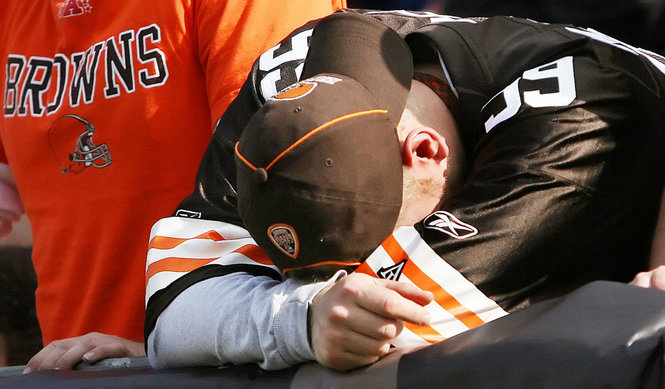
I have a coworker named Laura, who is a truly compelling person. She recently graduated with an MBA, is exceptionally gregarious, comes from a large Irish Catholic family, and is brilliant with children. She taught me the phrase and mindset, “set the child up for success.” She is also (perhaps ironically considering the mantra that she gave me) a Cleveland Browns fan. There are untold numbers of otherwise unique and complete people who also spend their time and energy following, supporting, and watching bottom-dwelling franchises.

This is a topic that has confounded me for some time: why do people invest their energy in teams that disappoint them? I had my own hypothesis, but I also asked Laura why she roots for the Browns. “It’s part of my identity,” she said. “Cleveland is my hometown, I’m not going to root for anyone else, and I want to have pride in where I come from. Even if the team is bad, the Browns are still a part of me.”

This sentiment about maintaining a sense of pride in one’s hometown through local sports was echoed by my friend Doug, a Redskins fan. I asked him why he stayed a Redskins fan despite their franchise problems. “I’m very much still a DC-first person at heart…. A lot of it just ties to the fact that I’m a native of the city and I always want to see the teams of this area win. And get the people from here some good times. Especially when we have such a unique status and culture between a predominantly black city and a city with no congressional representation.”

I think of myself, as a Jets fan. I was born in upstate New York, and my father was a Jets fan. We moved to Maryland when I was young, just as I was starting to become interested in sports. And despite the franchise’s incompetence over the past 45 years or so, I can look to the bond I have with my family, galvanized by our shared fandoms, as a source of pride. We feel that our fandom is a special relationship. And it is. It sets me apart, in a smaller minority, from all the Redskins fans and Giants fans and Cowboys fans and Steelers fans in the DC intake of people from all across America. I have a tie to a team with a smaller portion of the fandom market. It allows the failings of the Jets to get overlooked, when compared to the failings of the bigger teams.

I look at the way the Redskins treat their fans and the media, and think, “well, at least my team isn’t THAT bad.” My friend Doug put his relationship to the Redskins’ management woes succinctly: “I root for them to more and more begrudging levels when we consider the racist name, abhorrent owner, and incompetent management. It’s to the point where I root from them with a little more distance between myself and them.” But if I am honest with myself, I have no knowledge if the Jets’ management on a day-to-day level are as bad as the Redskins, since I get to keep their failings at a distance. I root for the team, but I need not consume all the information about them. I get to maintain the sense of loyalty and identity from a safe distance, at an intensity level that is comfortable for me. That is a relatively low intensity level, as I have little expectation of the Jets winning a Super Bowl in the near future. But it does not hurt to dream.

If fandom is, at its most extreme, about identity (and not necessarily about the team and its success) then one’s fandom, as a byproduct of where an individual comes from, is a core part of one’s identity. Moreover, if one’s team is bad, then all the fans of that team who remain are compelled by a sense of loyalty. To leave when the team is at its most vulnerable would be disloyalty, and a departure from the fanbase. One would lose a small part of their identity. And those who stay, may generate the benefits of loyalty through difficult times: a sense of superiority over those fans who have left, and over those fans who bandwagon upon other teams. This sense of moral superiority is only bolstered by a Messianic hope of a change in fortune for the team.

But this is just my thought experiment about the possibilities of what Laura told me. I’m not sure any fan would tell anyone else, to their face, that they possess a moral superiority because they are loyal. However, in light of our political times, we must be keen upon the depths to which identity affects us as individuals. How we hold these aspects of identity so dear, how they are expressed in our values. Fandom, increasingly, is a representation of our identity, alongside religion, race, and class, because it can reflect all of these markers of identity, as well as where we come from and where we live.

I would not overstate the role of fandom within identity- fandom is not universal to everyone. But to be a fan of a bad team, just as being a bandwagon fan, is an action related to an expression of a particular set of values. If we think critically about the way we support our teams, about our relationship to them from the point of view as fans, I believe that we can learn much more about ourselves in the process.

Introduction to Rowe Sports Talk Network

While this may technically be the first post written in this blog, this will serve more as an introduction than anything else. First, lets talk about how this came about.

It starts all the way back in 2014 when I was working for the Tennessee Smokies. I worked as a Media Relations intern for the team and also wrote for the Smokies website and the Smokies on Radio Network blog. When I signed up for the job, I didn’t realize I had do some broadcasting as well, and honestly I was glad I did. It allowed me to improve on my skills in broadcasting world even though I wasn’t planning on doing that with my life. It doesn’t hurt to have those skills if something that required broadcasting came up, right? Some of my co-workers at the time and now friends put together a podcast we called “Smokies Now” and after doing that for a few months I realized making podcasts were fun to do. If I was to go into broadcasting, it would be a sports talk show (TV or Radio or both). On the other side of things, I love to write about sports too.

So the next year I decided to put together my very own sports blog which I called The Sports Fanatical. In my blog I wrote opinion pieces, previews, reviews, columns, and I also did podcasts. That was absolutely perfect in my mind. I got so involved with it that it felt like a job, but at least it was fun. The next year when working for the Cincinnati Reds I was able to do a lot of work on the blog as new ideas kept popping up in my head to write or podcast about. Things were great until March of 2017 when the website I used changed it’s whole entire format. I couldn’t post podcasts unless I used SoundCloud, which I had to pay for if I wanted to keep all that I’ve done, articles past October 2016 were suddenly gone, I couldn’t see my audience numbers, and it also lost all the functions that were free. Essentially, what made the website so great for my platform did not work for me anymore. I’ll continue to use it until I get another job that pays more and allows me to afford to move it to WordPress which can allow me to pay for another blog on this website, but it’s disappointing to see that happen to what was a great sports blog website.

One day, at my current job, I was talking to my co-worker about sports blogs and it reminded me about how passionate I was about that blog. That night while drinking a couple of beers, I started to ponder over maybe going to WordPress to create a whole new sports blog. Then I thought to myself, why not start a blog where I can get multiple people involved. So I decided to check to see how much it was to pay for a blog with the capabilities of doing podcasts, videos, and whatever type of form of writing. And when I saw how inexpensive it was and that it was a one-time payment, then I knew I just had to purchase the plan. Later that night I decided to recruit a few people who I knew either from my professional or personal life to put some content up on the blog. Once I had a few people said that they wanted to, I decided to follow through with doing this. Considering I love sports talk and I knew some people who were in the business, I just had to. So that’s how I got to this point and that’s how this blog came to be.

So the point of this blog, while trying to be as professional looking and as great as possible, is to give people a chance to just do it for fun, if they are an aspiring writer, or even if they are already a professional writer and professional broadcaster. Even though I could not pay them, I wanted to pay to be able to get them to get creative with this sports blog so that maybe that this website is a platform for them to showcase their talents and for them to go on to do bigger things. However, I also hope that this could also become something big. If in the future, someone see’s this blog and wants to invest in it to make it into something like 120Sports or even as big as ESPN. Sure it’s a big goal, but dreaming big some times gets people some where.

So that’s the introduction to Rowe Sports Talk Network. Hopefully you enjoy what type of content that is posted by us. I would also like to hear from the readers about suggestions or improvements over what is posted. However, I know from the people I recruited to write on this blog, I hope you the readers are genuinely pleased. Here’s to a great start and here’s to hopefully it becoming big.